

We like to think we’re in control, that our choices are ours alone. That every path we walk was picked deliberately, carefully, consciously. But what if the biggest decisions aren’t really choices at all, but collisions — moments when the universe drags us by the collar and demands we pick one thing over another?
That’s the heartbeat of my upcoming short story, The Choice.
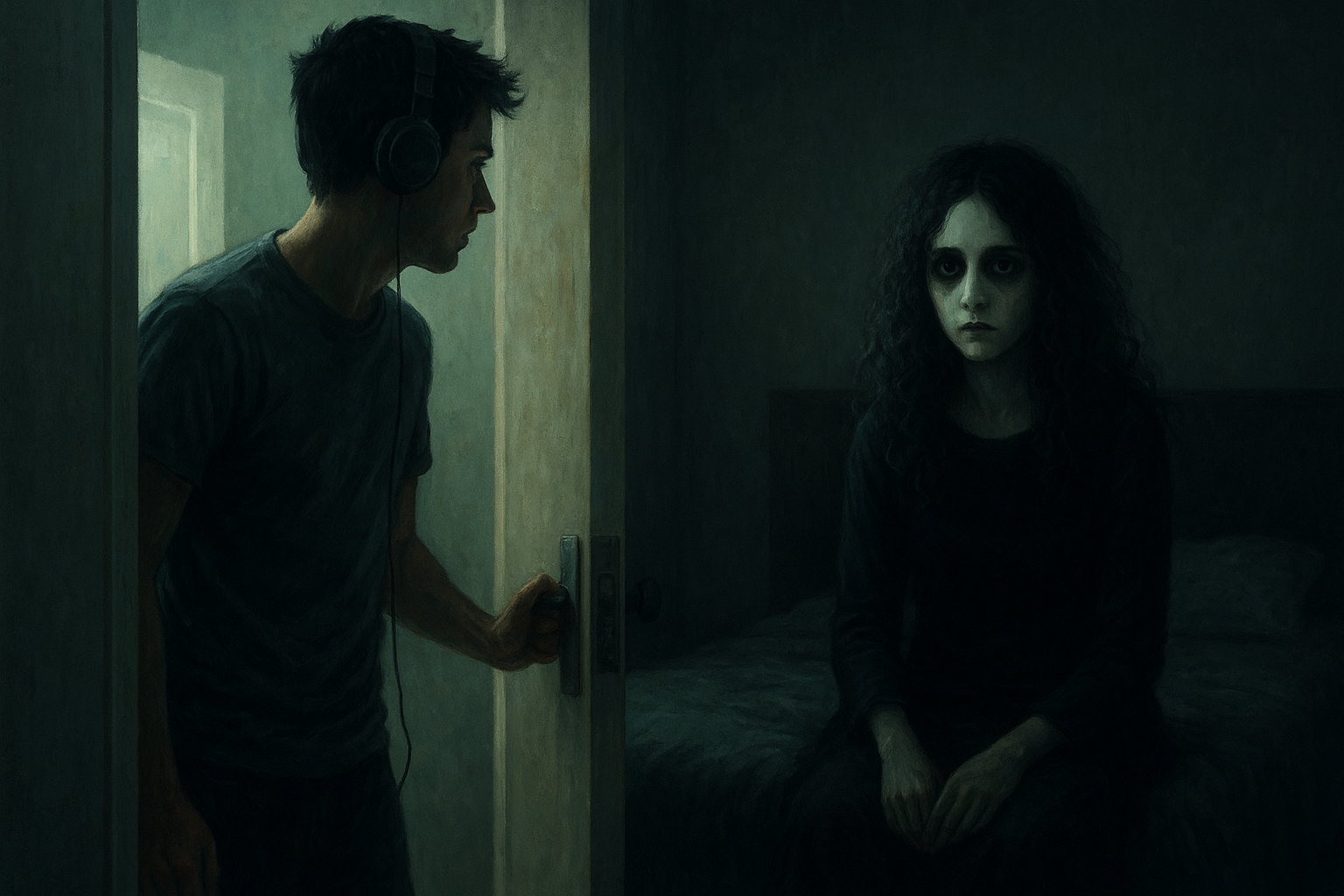
The story isn’t just about a man named Austin Luca, a manager working at McDonald’s who wants nothing more than to be a writer. It’s about the night something — or rather, someone — showed up and forced him to confront what he wanted most.
Ana.
She doesn’t kick down the door. She doesn’t announce herself like some ghost in a horror movie. She just appears, seated calmly on Austin’s bed, elegant in black, smiling with that unsettling confidence of someone who knows more about you than you’ll ever admit. She isn’t there to kill him, or haunt him, at least not in the literal sense. She’s there to corner him into a truth he’s been avoiding:
You can’t live halfway forever.
That’s where the story cuts the deepest for me, because The Choice grew out of my own life. I was Austin once. Not in the sense of having a strange woman appear in my apartment, but in the sense of feeling haunted by a presence I couldn’t shake. My “Ana” was doubt, self-loathing, the relentless question of whether chasing writing was worth the sacrifice. Every day, I put on a McDonald’s uniform, and every night, I came home to my notebook. I was choosing and un-choosing at the same time. Routine becomes its own kind of prison. You wake, you clock in, you clock out, you dream of something better, then repeat the whole damn cycle until you convince yourself it’s life. Routine makes cowards of us because it makes us believe safety is enough.
But Ana isn’t interested in safety.
She tells Austin what every dreamer secretly fears: he can’t have both. He can’t cling to comfort and still demand greatness. He can’t say he wants to be a successful writer while pretending that love, stability, and “normal life” will wait patiently for him in the corner. She forces him to see that every decision, every small act of hesitation or routine, is already a choice.
That’s why the story feels less like fiction and more like a confession. Because when I wrote it, I wasn’t imagining Austin’s life; I was writing my own dilemma into existence. Should I give everything to the page, even if it meant losing people I loved? Or should I hold onto comfort and let the dream slip away?
Most of us know that feeling. Maybe it’s not about writing. Maybe it’s about leaving a job, moving to another city, or walking away from someone who no longer sees you. But the same truth stalks all of us: safety and desire rarely sit at the same table.
The horror of The Choice isn’t just Ana’s presence; it’s the realization that she isn’t some demon or ghost. She’s a mirror. She’s every whisper you’ve ignored, every time you’ve asked yourself if you’re wasting your life. She’s that stranger on your bed who smiles and says, “You already know the answer, don’t you?”
And maybe that’s the real point of the story: we don’t get to escape choosing. Even when we pretend we’re standing still, even when we drown ourselves in routine, we’re still making choices. Not choosing is a choice. Waiting is a choice.
What The Choice asks is simple but brutal: what will you sacrifice, and what will you fight for?
When I finally typed the last words of the story, I didn’t feel triumphant. I felt stripped bare. Like I had put my worst fear on paper and stared at it until it stared back. Writing it didn’t solve my life, but it reminded me of something Ana herself would have said: you don’t need to know how the story ends, you need the courage to keep writing it.
And maybe that’s the only choice that really matters.
——
Discover more from Gabriel Lucatero
Subscribe to get the latest posts sent to your email.