

The application required an emergency contact, which seemed presumptuous for a job that paid eighteen dollars an hour. I put down my brother’s name, but then I remembered we hadn’t spoken in eight months, and if someone called to tell him I’d been crushed by warehouse shelving, he would probably ask what I’d done to the shelving.
I deleted his name.
There was a man at the next computer filling out the same application. He wore a tie with a small grease stain near the bottom and had been staring at his screen almost as long as I had.
“Who are you putting?” I asked.
“What?”
“For your emergency contact. Who are you gonna put?”
“My mother.”
“She reliable?”
“Been dead since March. But they never call.”
I looked at the empty field.
“You can put me,” I said. The offer came more easily than “I love you” ever had with my last girlfriend, who would probably have appreciated knowing that.
He turned toward me.
“Fifty bucks,” I added.
“For what?”
“To answer the call. Whatever happens, I’ll pick up the phone.”
He considered this with the seriousness of a man comparing dental plans. I was beginning to feel ridiculous, but he hadn’t said no.
“Would you come to the hospital?”
“Within reason.”
“What’s reason?”
“County limits. International services will cost more.”
“You want all the money now?”
I hadn’t thought that far ahead.
“Fifty percent now,” I said. “The rest when I get the first call.”
He pulled out his wallet and handed me twenty-five dollars. We exchanged numbers. Neither of us got the job that day.
***
His name was Roger. His emergency came eleven days later, when he cut off the tip of his finger at a restaurant that had hired him without checking if he knew how to handle a meat slicer.
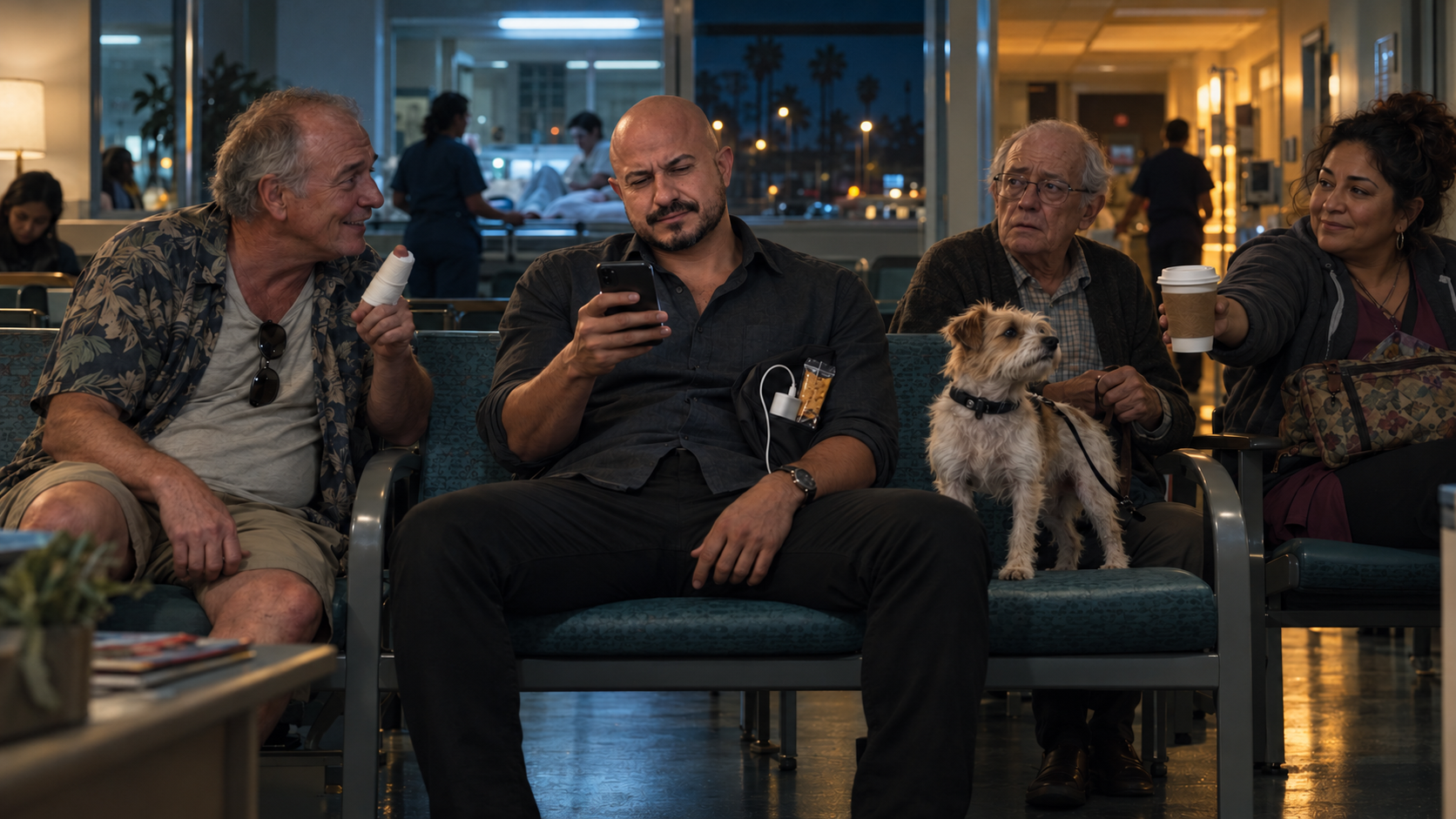
I met him in the emergency room. He raised his bandaged hand when he saw me.
“You came.”
“I said I would.”
“Within reason.”
“Correct.”
He smiled and shifted his jacket off the chair beside him. I wondered how long he’d expected to sit there before trying somebody else.
I brought him home, picked up his prescription, and listened while he explained that the slicer’s safety guard slowed everything down. Apparently, he had been doing the restaurant a favor.
Before I left, he paid the balance and asked whether the fifty covered the following month.
“No,” I said. “Just the first month.”
He asked me to put him down for another.
***
Roger referred two people. One was divorced, and the other had six children and said he wouldn’t trust any of them to identify his body without making it about themselves.
By the end of the month, I had nine clients. I created an ad and shared it on Facebook, Instagram, and TikTok:
IN CASE OF EMERGENCY. A real person. A working vehicle. No judgment. $50/month.
I removed “No judgment” after a man asked whether I would collect a duffel bag from his apartment before the police arrived.
Most calls involved ordinary disappointments. A woman needed someone to drive her home after a colonoscopy. A school called because a client’s daughter had a fever. An urgent care clinic needed somebody to sit with a man who had taken two sleeping pills and then become frightened that they were working.
People told me things while we waited. Affairs, debts, and the precise amount of alcohol they considered medicinal. One man admitted he’d never understood his job and had been promoted twice. I asked whether they were hiring.
I kept detailed notes on my phone:
Marisol: penicillin allergy. Sister in Phoenix. Do not call sister.
Warren: dog named Kevin. Kevin bites.
Roger: ask whether finger healing. Don’t say growing back.
For an additional twenty dollars, clients could purchase Follow-Up, which included a call the next morning and a sincere question about how they were feeling.
Almost everyone bought it. I was getting good at listening, though sometimes I had to remind people that the follow-up was about yesterday’s emergency. New developments required some discretion.
***
Fabiola, my then-girlfriend, thought the business was depressing. She brought this up regularly over drinks at Convivo, where my depressing business paid the tab.
“You’re charging people to care about them.”
“I’m charging people to pick them up. The caring should be automatic, don’t you think?”
“Who’s your emergency contact?”
“I’m working on that.”
She watched me eat standing over the sink because I had to collect a man whose wife had dropped him at a psychiatric facility and gone to Palm Springs for some “girl time” with her friends. According to him, she was sleeping with the gardener. He mentioned it often enough that I eventually put it in his notes.
“You could put me,” Fabiola said. “I wanna be your emergency contact.”
“I know.”
After a while, she stopped mentioning it.
Before you write me off as an insensitive man, understand that Fabiola had a boyfriend of two years who did everything for her while she spent furtive afternoons with me. I occupied roughly the same position as the gardener, and I had doubts about whom she would answer first if both of us ended up in the hospital.
***
At twenty-three clients, I needed a spreadsheet. At thirty-one, I started keeping a clean shirt, phone chargers, and crackers in the trunk. At forty-seven, I knew more medical histories than most of the families involved.
I also knew which apartment doors stuck, who would understate chest pain, and which people became unpleasant when frightened. Warren cried before every procedure. Marisol apologized for everything, including bleeding on the upholstery.
One Thursday, a surgeon took me into a small room and explained that a client named Arthur had died.
I had driven Arthur to two appointments. He used to bring a folder containing every document he’d ever received, including the instructions for a blender.
“Was he in pain?” I asked.
The surgeon nodded apologetically.
Arthur’s son arrived forty minutes later. He wore expensive running shoes and kept checking a watch that was also a telephone.
“Who are you?” he asked.
“His emergency contact.”
“I’m his son.”
I waited while he looked toward the closed door.
“Did he say anything?”
“He wanted me to feed his cat.”
“I mean about me.”
I looked at the veterinarian’s number Arthur had written on an envelope.
“He said you lived in Portland.”
After the funeral, the son asked whether I could come by his hotel. He wanted to hear about his father’s last few months.
I could have explained that I’d only known Arthur for six weeks. By then, though, I disliked him enough to charge my evening rate.
“Seventy-five an hour,” I said.
He paid for three.
***
The trouble started with scheduling. Roger needed a ride home. Marisol had fallen in the shower. Warren believed Kevin had eaten a battery, although the battery was later found in Warren’s robe.
I missed dinner with Fabiola, then her birthday breakfast, which we had scheduled specifically because I’d missed dinner. Both involved a hotel room and very little food.
“I can’t keep reserving time you sell to somebody else,” she said.
I offered to turn off the phone, but it rang while I was saying it.
“Answer it.”
There was a resignation in her voice I recognized from hospital waiting rooms.
***
By November, I was sleeping four hours a night and drinking gas-station coffee that had been on the burner since the previous shift.
I hired a retired man named Paul to cover weekends. On his first Saturday, he told a client that a panic attack was “mostly attitude” and took another client to the wrong hospital because parking was free.
I refunded both calls. Paul said I was too emotionally involved.
That night, while carrying groceries up to Marisol’s apartment, I felt a pressure in my chest. I sat down on the stairs with a bag against each knee.
Marisol found me there.
“You look terrible.”
“It’s been a long day.”
She took the bags.
“Should I call someone?”
“I’m already here.”
She didn’t laugh. That worried me enough to go to the hospital.
***
The admitting clerk asked for my emergency contact, and I automatically gave her my number.
“That’s your number.”
“Yes.”
“Somebody else.”
I opened my contacts. Roger would come, but he couldn’t drive until his next appointment. Warren would bring Kevin. My brother’s number might still work. I scrolled past Fabiola’s name twice.
“Can I fill that in later?”
The clerk pushed the form aside, and a nurse took me back. She attached wires to my chest and asked about stress. I explained the business while she worked.
“How many people?”
“Forty-seven.”
“And you couldn’t think of one?”
I watched her press an adhesive pad against my skin.
“I could think of several,” I said. “I didn’t want to bother them.”
She handed me my phone.
“Bother one.”
I called Marisol. She answered before the second ring.
“Did you leave something?”
I told her where I was.
“I’ll be there.”
“You don’t have to.”
“I know.”
She arrived with a phone charger and the crackers from my car. I started to thank her, but she pulled a chair close to the bed and sat down.
For the first time in months, I fell asleep with the ringer off.
***
Two days later, Marisol called to ask how I was feeling.
“Better. Doctor said it’s stress.”
“Did he tell you to slow down?”
“Among other expensive suggestions.”
“I’ve been thinking about your business.”
I sat up a little.
“You need help,” she said. “And I need work. We should talk.”
We met that afternoon. She brought a notebook, several practical suggestions, and a list of questions about mileage. At the bottom of the page, she’d written my name.
“What’s that?”
“Your account.”
I looked at her.
“Fifty a month,” she said. “Twenty extra if you want me to call tomorrow.”
THE END
——————
*If you enjoyed this short story, consider a donation. Much appreciated.
Discover more from Gabriel Lucatero
Subscribe to get the latest posts sent to your email.