
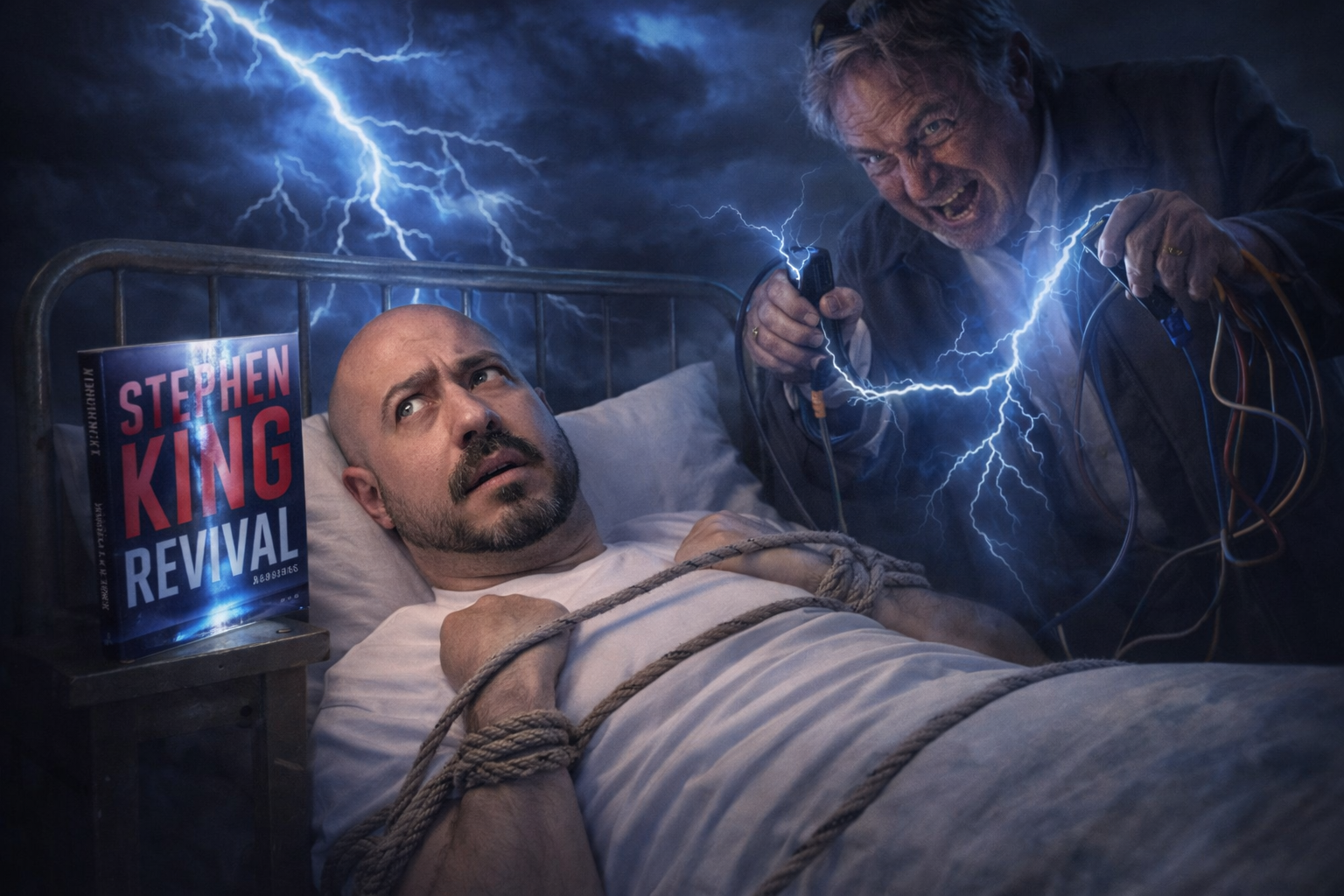

Let’s cut the niceties: Revival is Stephen King’s most unsettling work, and not always for the reasons you’d expect. More than a horror story, it’s a philosophical gut punch wrapped in a slow-burning narrative that dares you to hate it. It’s not the kind of book you’ll casually recommend to friends. No, Revival is the literary equivalent of a dare. You don’t give it to someone unless you’re ready to watch them squirm. Because while it’s bold, even brilliant in places, it’s also punishingly bleak and frustratingly uneven.
At its core, Revival is a dark exploration of faith and obsession, but don’t get too comfortable. King isn’t here to offer redemption arcs or tidy resolutions; he never does, and that’s one of the reasons why I like most of his books. In this novel, he introduces us to Charles Jacobs, a preacher-turned-mad scientist whose descent into darkness is as inevitable as it is unnerving. Jacobs might be King’s most fascinating villain in years, cut from the same cloth as Annie Wilkes in Misery, but terrifyingly human in his own right. He’s the man who loses everything, burns his faith to the ground, and decides that if God won’t give him answers, he’ll carve them out himself, even if it means breaking every rule on the way down.
And then there’s Jamie Morton, our narrator, whose journey is equal parts tragic and infuriating. I wouldn’t call him a hero, not even close. He’s more like the guy who shows up, watches things collapse, and walks away scarred for life. If you’re hoping for someone to root for, good luck. But here’s where it stings: I saw a lot of myself in Jamie Morton, and I hated it. Like Jamie, I’ve been guilty of standing on the sidelines, of letting life happen to me instead of taking charge. It’s an uncomfortable mirror to look into, but that’s the point.
And Jacobs? We’ve all met someone like him. That charismatic leader who knows exactly what to say to make you believe, whether it’s a preacher, a politician, or an ex with the ego and arrogance of Trump. Jacobs embodies that dangerous blend of brilliance and manipulation, and King nails it with unnerving precision. What makes Revival work, when it works, is how lean and merciless King’s prose feels. The man’s always been a storyteller, but here his writing cuts sharper than usual. There’s no fluff, no wasted breath, every line a scalpel. And through that stripped-down style, he tackles questions so heavy they feel radioactive: life, death, faith, and the terrifying possibility that there’s absolutely nothing waiting for us on the other side. It’s not comforting, but it’s honest, and honesty has always been King’s most dangerous weapon.
And then comes the ending. If you’re expecting catharsis, abandon hope now. King doesn’t let you off the hook with light or redemption. Instead, he yanks the floorboards out and drops you into a void so nihilistic it makes Pet Sematary feel like a bedtime story. But for all its brilliance, the novel falters. The first half has that vintage King atmosphere, rich, immersive, and full of the small-town textures only he can conjure. Then the middle bogs down. The pacing crawls, as if King got so lost in the details of Jamie’s life that he forgot he was building toward horror. And Jamie himself, already passive, sinks further into bystander territory. It’s deliberate, sure, but it leaves the story adrift.
So what is King trying to say with Revival? On the surface, it’s a cautionary tale about blind faith and unchecked ambition. But scratch deeper, and it feels more like a middle finger to the comforting lies we tell ourselves about life and death. Some readers will find liberation in that honesty. Others will recoil. But either way, that’s the point. Like so much of King’s work, Revival reminds you that life is messy, faith is fragile, and the answers we crave might not exist at all.
So, is it worth your time? That depends. If you’re chasing a classic King scare-fest, you’ll be disappointed. But if you’re willing to wrestle with existential demons, this book will strike you like a lightning bolt. It’s slow, uneven, and relentlessly bleak, but also brave, bold, and unapologetically honest. In a world where so much fiction plays it safe, Revival dares to be dangerous. And maybe that’s the real horror. Not the monsters under the bed or the creatures lurking in the dark, but the cold, hard truth that sometimes, there are no answers.
——
If you enjoyed this review, consider donating to the cause. My future children will thank you for it.
Discover more from Gabriel Lucatero
Subscribe to get the latest posts sent to your email.