
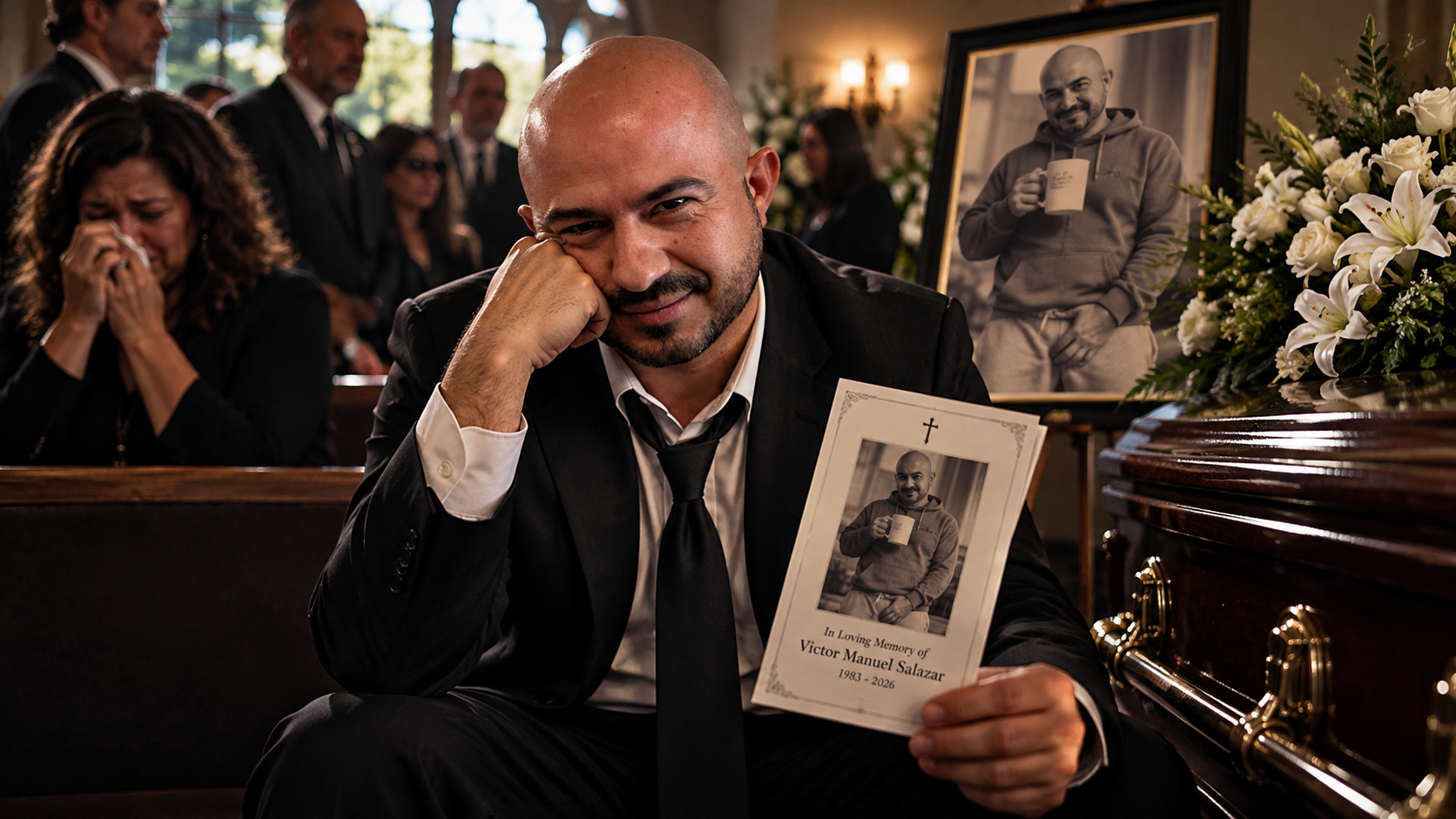

Victor had always suspected his family would enjoy his funeral more than his birthday. What surprised him was receiving an invitation.
It arrived on a Thursday, between an electricity bill and a coupon for hemorrhoid cream. The envelope was black, which Victor considered unnecessarily dramatic; death was already a fairly serious subject, and there was no need to dress it like a fucking magician. Inside was a card announcing the death of Victor Manuel Salazar, aged forty-three, beloved son, brother, husband, and friend.
Victor had objections to nearly every word.
His mother was dead, his brother owed him six thousand dollars, and his wife had left him for a chiropractor named Dennis. As for friends, he had two, provided the bartender at Mel’s counted. The card included a photograph of Victor standing outside his apartment, smiling, holding a coffee mug, and scratching his balls through his sweatpants. He recognized the photograph immediately because he’d been wearing those same sweatpants that morning.
“Very funny,” he said.
The funeral was scheduled for Saturday at eleven. Victor considered calling the police, but explaining that someone had invited him to his own funeral seemed like a good way to spend the afternoon answering questions about his mental health. Instead, he called his brother.
“Did you send me something?”
“Like what? Money?”
“No, asshole. A funeral invitation.”
“Whose funeral?”
“Mine.”
There was a long silence.
“Well,” his brother finally said, “are you going?”
Victor hung up.
Saturday arrived with the kind of sunshine Victor considered personally offensive. He wore his only black suit, purchased twelve years earlier for a wedding that had ended in divorce, and drove to McDermott-Crockett, the funeral home on Chapala St., just inches away from Mission Tatoo, where Victor had committed the worst mistake a horny man can make: tattoo his woman’s name on his chest.
The funeral home’s parking lot was full, and that bothered him more than the invitation. He’d spent the previous evening estimating attendance and had settled on seventeen people, including anyone who might wander in looking for the bathroom. Inside, a large photograph of Victor stood beside an arrangement of white lilies. It was a much better photograph than the one on the invitation, making him look younger, thinner, and considerably less disappointed with humanity.
“Where the hell did they get that?”
A woman brushed past him without apologizing. Victor recognized her as Mrs. Henderson, his former neighbor, who had once accused him of stealing her newspaper. Seeing that she was crying, Victor decided to follow her into the chapel, where nearly every seat was occupied. His coworkers sat together near the front, and his brother occupied the first pew, looking devastated in a dark blue suit Victor was fairly certain he’d purchased with borrowed money.
His ex-wife, Patricia, was there too, crying. Victor hadn’t seen her cry since the divorce proceedings, when the judge refused to award her his retirement account. He took a seat near the back as the service began with a hymn, followed by a speech from his boss, Mr. Reynolds.
“Victor was the heart and soul of our department,” Reynolds said.
Victor nearly choked. Three weeks earlier, Reynolds had described him as a man whose greatest professional achievement was remembering to clock in.
“He always put others before himself.”
“Bullshit,” Victor whispered, although he appreciated the sentiment.
Reynolds continued for another five minutes, describing a generous, hardworking employee whose positive attitude had inspired everyone around him. Victor found the whole thing rather touching, and wondered whether he could record it and play it during his next performance review. Then, Patricia approached the podium.
“My husband,” she began.
“Ex-husband,” Victor corrected.
She dabbed her eyes with a tissue and said, “Victor wasn’t always an easy man to love.”
“Here we go.”
“But he had a good heart.”
Victor leaned forward, waiting for the other shoe to drop.
“He was funny, intelligent, and sometimes terribly lonely. I wish I’d told him more often how much he meant to me.”
Victor felt something tighten in his throat. For years he’d imagined Patricia regretting the divorce. Usually the fantasy involved her showing up at his apartment during a thunderstorm, begging forgiveness while Dennis suffered a catastrophic chiropractic accident. But this was better. The fact that she was crying in public made him enjoy his own funeral.
During the reception, Victor discovered several fascinating things about himself. He’d apparently donated money to children’s charities, volunteered at the Rotary Club, mentored younger employees, and once rescued a dog from a burning building. The dog incident particularly impressed him because he’d never owned a dog and was mildly allergic to them; he was more of a cat person, too. His brother stood beside the refreshments, telling a group of mourners how Victor had helped him through difficult financial times.
“Six thousand dollars,” Victor muttered. “And you still haven’t paid me back.”
Nobody acknowledged him.
He approached Patricia, who stood alone near a window.
“You know,” he said, “that was a beautiful speech.”
She stared into her drink.
“I appreciate what you said about me.”
Her eyes filled with tears.
“Victor,” she whispered.
“Yes?”
“I’m sorry.”
He smiled.
“Well, it’s a little late, but—”
“I should have listened.”
Victor’s smile faded.
“Listened to what?”
She covered her mouth.
“I knew something was wrong.”
Before he could ask what she meant, his brother appeared and embraced her. Victor watched them hold each other. Then he noticed the funeral director standing in the doorway. The man was elderly, with silver hair and the exhausted expression of someone who’d spent forty years dealing with grieving families and their catering complaints.
He was staring directly at Victor.
Finally, someone who could see him.
“Excuse me,” Victor said, approaching him. “I think there’s been a misunderstanding.”
The director remained silent.
“I’m Victor Salazar. The deceased, apparently.”
The old man looked past him toward the chapel.
“Sir,” he said quietly, “you need to stop.”
Victor frowned.
“Stop what?”
“You’re upsetting everyone.”
Victor glanced behind him. Nobody was paying attention.
“I haven’t done anything.”
“Please. You’ve been standing in front of that coffin for twenty minutes.”
Victor turned toward the chapel. Through the open doors, he could see the coffin resting beneath the flowers, its lid raised. He walked toward it, only to find that the coffin was empty.
“There’s nobody in there,” he said.
The director didn’t follow.
“Sir, please.”
Victor leaned closer, examining the white satin lining.
“See? Empty. Someone’s made a mistake.”
Behind him, a woman screamed. Victor turned. Patricia had collapsed into his brother’s arms. Several mourners rushed forward. Mr. Reynolds stood frozen beside the doorway. Victor looked back into the coffin. For one brief moment, he saw something. A pale hand resting against the satin.
His hand.
Then it was gone.
The chapel emptied slowly. Victor remained beside the coffin, waiting for someone to explain the situation. He had several questions, most of them reasonable. The funeral director returned after the last mourner had left.
“Are you finished?” the old man asked.
Victor studied him.
“You can see me.”
The director sighed.
“Unfortunately.”
“Then I’m not dead.”
“That’s not how it works.”
Victor looked down at his hands. They seemed normal enough. His fingernails needed trimming, and there was a small scar near his thumb from an incident involving a can opener and a regrettable amount of whiskey.
“I don’t understand.”
“Most people don’t.”
The director reached into his jacket and removed a folded piece of paper.
“Your brother found you Thursday afternoon. You’d been dead for several hours.”
Victor stared at him.
“That’s impossible. I got the invitation Thursday.”
“Did you?”
“Yes! And I even talked to him on the phone!”
“You only think you did,” the director said. “That didn’t really happen.”
“And the photograph?”
“There was no photograph, Mr. Salazar.”
“Then what the hell did I see?”
“Something you remembered. Or imagined. The mind doesn’t always understand when the body has finished with it.”
Victor remembered standing outside his apartment with his coffee. The morning had been cold, and he’d been waiting for a delivery that was already late. When he went back inside, he caught his reflection in the mirror Patricia had installed beside the door. He smiled. He always did, although he couldn’t have explained why. Perhaps it was habit. Perhaps he still expected to see her standing behind him.
Then came the pain.
He remembered gripping the kitchen counter, struggling to breathe, and reaching for his phone.
After that, nothing.
Victor sat down in the first pew. For a while, neither man spoke.
Finally, Victor asked, “So what happens now?”
The director straightened his tie.
“That depends.”
“On what?”
“Whether you’re ready to leave.”
Victor considered the question. He thought about Patricia’s speech, his brother’s tears, the coworkers who’d apparently liked him more than he’d realized. He thought about all the wonderful things people had said after he was gone.
“Can I come back next year?”
The director stared at him.
“To your funeral?”
“An anniversary service, maybe. People seemed to enjoy themselves.”
“Mr. Salazar—”
“I’m just saying, it was nice hearing something positive for a change.”
The director closed his eyes.
Victor smiled.
“Do you think they’d do it again?”
“No.”
“Not even something small?”
“No.”
Victor sighed.
“Fine.”
He stood, adjusted his jacket, and took one last look at the coffin.
“Well, I suppose that’s that.”
The director opened the chapel doors. Beyond them was a long, dark corridor Victor hadn’t noticed when he arrived. He approached it, then stopped.
“One more thing.”
The director waited.
“My brother owes me six thousand dollars.”
“And?”
“Does dying cancel the debt?”
The director hesitated. Then, for the first time that afternoon, he smiled.
“No, Mr. Salazar. It most certainly does not.”
Victor grinned.
“Good.”
He stepped into the darkness.
“Because that motherfucker is going to be very surprised when I get home.”
THE END
——————
*If you enjoy this short story, consider a donation. Much appreciated.
Discover more from Gabriel Lucatero
Subscribe to get the latest posts sent to your email.