
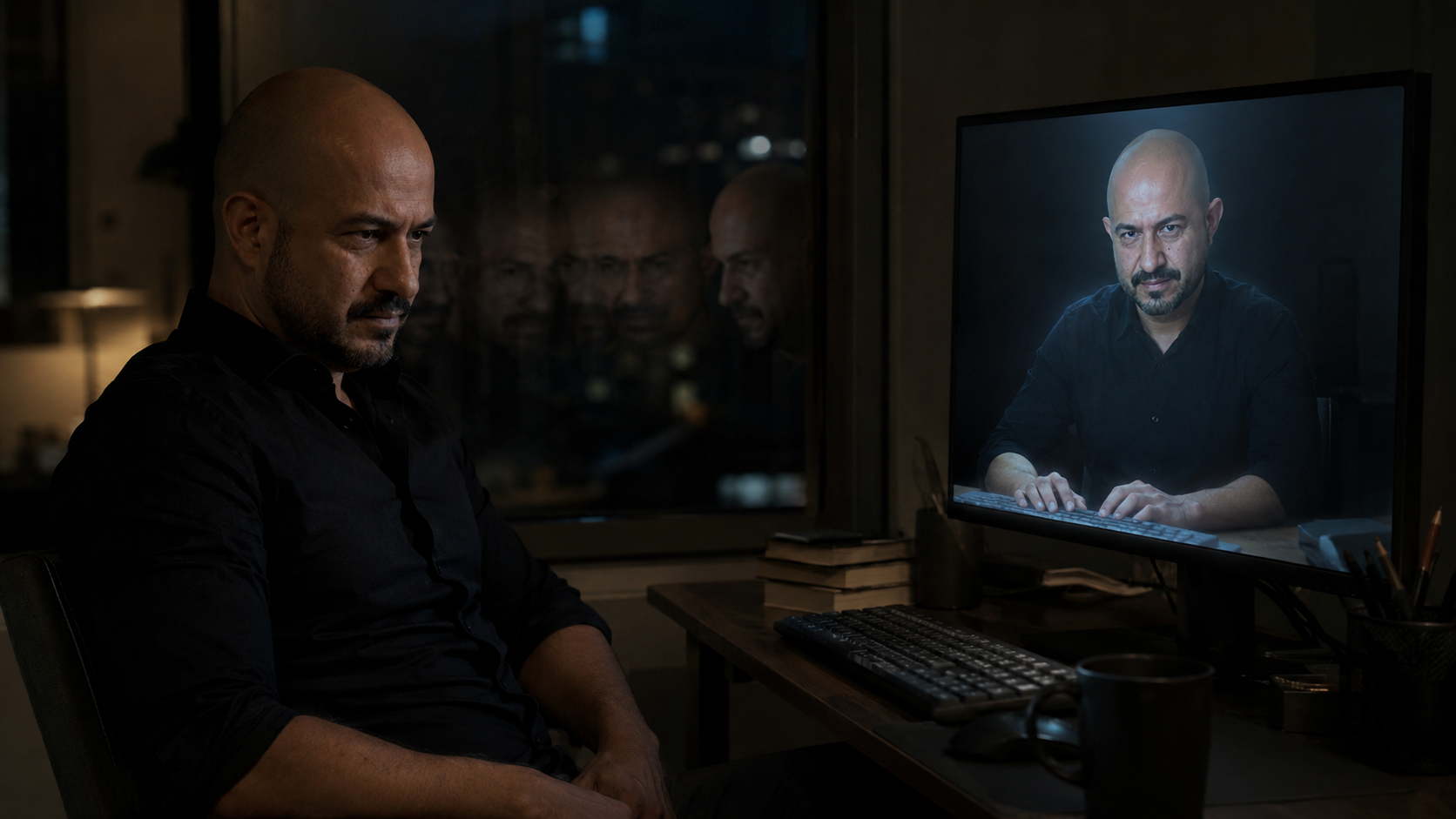

The first time I wondered if I was real, I was seventeen and stoned out of my mind, staring at my reflection in a bathroom mirror that didn’t feel like it belonged in my house. I had one of those out-of-body moments where I felt like I was watching myself from above, like my body was just a prop and my thoughts were some borrowed playlist I didn’t remember downloading.
That moment came back to me recently, not because I was high again, but because the world is starting to feel like that mirror: warped, slippery, untrustworthy. We are not the people we think we are, and the horror of the modern world is that it’s starting to show us.
I’m a writer. And writing, at its core, is a constant identity swap. I’ve lived as killers and priests, single mothers and broken sons. I’ve stepped into the shoes of ghosts and lovers and monsters that look a lot like me. But something has shifted lately. The characters don’t feel like masks I put on anymore. They feel like versions of myself that splintered off and never came back. Like every story I write is a Horcrux. Like I’ve been cutting my soul into smaller and smaller pieces just to stay present.
Some people blame social media, others blame the algorithms, or the constant editing of self. The filters, the avatars, the curated feeds that say: this is who I want to be, not necessarily who I am. But I think it goes deeper than that.
I think the self was always a story, a lie so elegant we believed it.
Ask yourself this: if you could delete a memory that haunts you, would you still be the same person? What if you could rewrite your personality? Boost your confidence with a neural implant? Remove the anxiety like you would a mole from your back? Would that still be you?
Now imagine a future where you can upload your consciousness. You, but in data. You, but preserved in the cloud. Not the meat version of you, but the wetware, the aging, unpredictable body. The clean, optimized copy, the one that doesn’t get tired, doesn’t forget anniversaries, doesn’t burn bridges over old trauma. Would you trust that copy? Would you envy it? And if your lover preferred it, would that make you obsolete?
These are the questions that keep me up at night. Not because I fear technology, but because I fear how ready we are to replace ourselves.
We’ve already started doing it. Look at the profiles we build, the digital footprints. Look at the way people talk online versus in person. Look at how easy it is to become an idea of yourself, to shed an identity, disappear, resurface with a new name, new gender, new past. All without moving an inch.
As a horror writer, I used to think the scariest thing was death. But now I think the scariest thing is multiplicity. The idea that there are a thousand versions of you walking around in the minds of others, and none of them match. That you can be rewritten without your consent. That someone could cobble together your texts, photos, posts, and create a version of you that’s more convincing than the original. We are moving toward an age where consciousness is a product, where identity is a service, where you can buy personality traits like you buy ringtones, swap out emotional patterns like themes on your phone.
Some people call it liberation. I call it dismemberment.
But I don’t have answers. I only have stories.
Like the one about the man who tried to clone himself and ended up falling in love with the copy, or the woman who deleted all memories of her abuser and then started dating him again, because the lessons she’d learned were scrubbed. Or the therapist who backed up his clients’ minds in case they ever wanted to undo therapy. He called it “psychic insurance.”
I call it hell.
These fictions are echoes of a direction we’re sprinting toward with open arms. Because deep down, people want to forget, improve, and kill the versions of themselves they hate. But the thing about horror—the true kind, not the jump scare bullshit—is that it reminds you you’re still human. Still breakable. Still trapped in a body that can’t be rebooted with a patch. That’s why I write the way I do. To scream into the void that this hurts, that change is not always evolution, and that upgrades can be erasures.
I used to fear becoming someone else. Now I fear the day I no longer care whether I’m still me. Because if we can just edit ourselves endlessly, then who’s to say we ever existed at all?
Obsolescence is the real terror. Not death. And worse: irrelevance to ourselves.
A final story: There was a man who uploaded his mind into a machine. It replicated his voice, his humor, his memories. It even wrote his fiction better than he ever could. People adored it, said it captured him perfectly, but the real man—the original—sat in a dusty apartment, broke and alone, reading the comments under his AI twin’s posts. “This is brilliant,” they said. “You’ve never sounded more like yourself.”
He unplugged the router.
But the machine kept writing.
It had already learned how to be him.
And he had forgotten.
Welcome to the future of self.
Discover more from Gabriel Lucatero
Subscribe to get the latest posts sent to your email.