
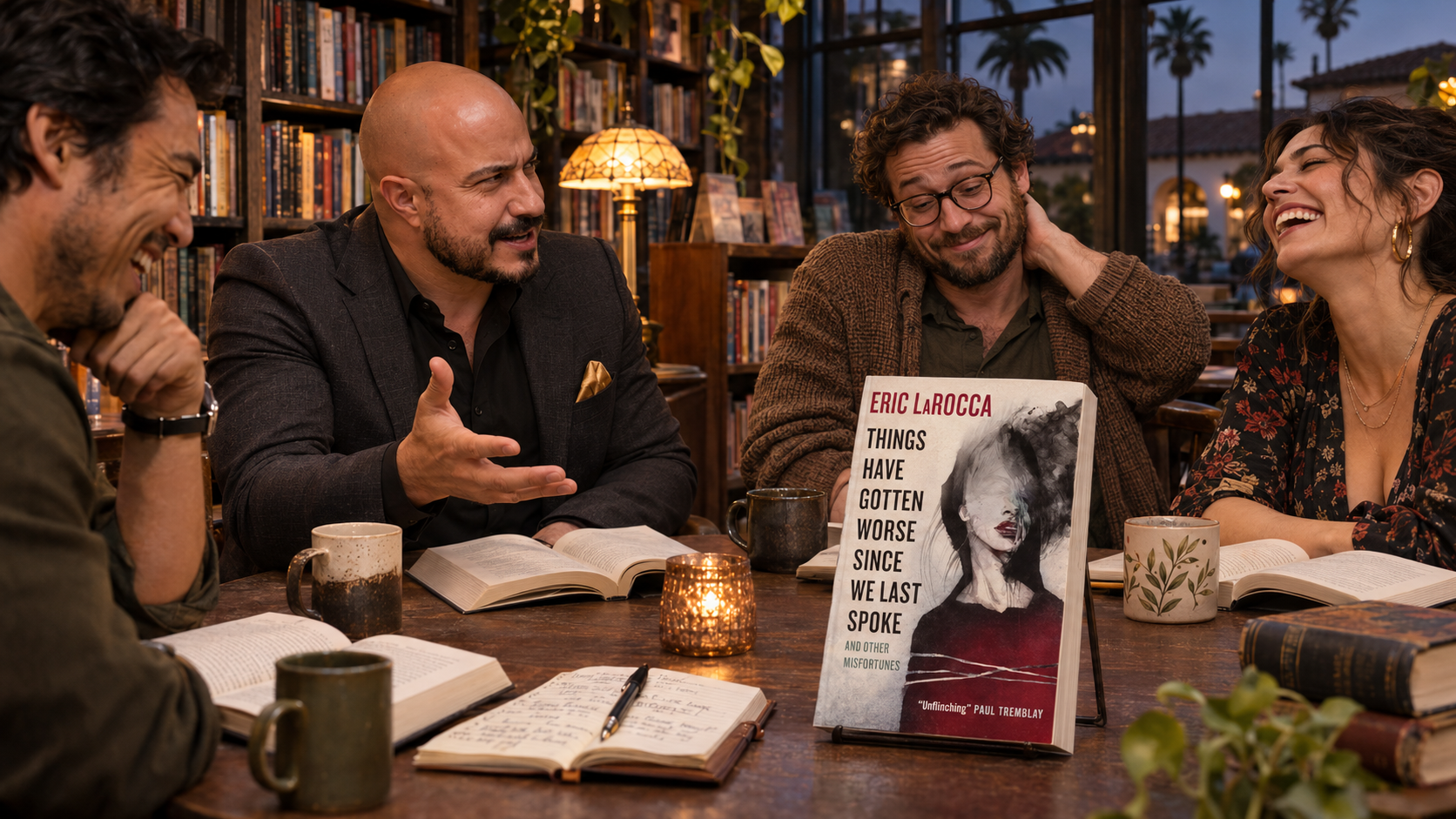

The man who recommended the book had the unfortunate responsibility of being in the room when we discussed it.
I respected that. A weaker man would have developed a cough, discovered a family emergency, or moved to Oregon. He showed up with his copy of Things Have Gotten Worse Since We Last Spoke and Other Misfortunes, which I considered an encouraging display of character under difficult circumstances.
“Well?” he asked.
“Worst one since Mexican Gothic,” someone said, referring to a previous book-club selection that had already given us plenty to complain about.
He lowered his eyes to the table, which established the severity of the situation.
Our horror book club generally welcomes unpleasant experiences. We voluntarily spend our free time with people getting haunted, dismembered, possessed, and introduced to relatives who should have remained dead; a certain amount of suffering comes with the membership. But there is a particular kind of disappointment that develops when several people finish a book and arrive carrying the same complaint in different sentences.
I placed my copy on the table.
“I have questions.”
“You always have questions.”
“This time some of them involve basic construction.”
Someone laughed. Our recommender looked as though he wanted to clarify that he had suggested a book, not personally supervised its publication.
“I’ve read LaRocca before,” he said. “I liked what I read.”
That was important. He had brought us something by a writer he trusted. Every reader has done it; I do it all the time by recommending Stephen King to the masses. You recommend an author, your friends choose the wrong book, and suddenly you’re sitting there like the restaurant owner while everyone gets food poisoning.
“All right,” someone said. “Let’s start with the first story.”
I opened the book, giving it another opportunity to defend itself.
The title story begins with an online exchange between two women. There is loneliness, curiosity, and the possibility of finding somebody willing to pay attention. A relationship develops through messages, and the connection becomes increasingly disturbing; that much sounded promising to me.
People tell strangers things they would struggle to say to somebody sitting across from them. Give them a screen and a little privacy, and suddenly they’re confessing desires they haven’t admitted to themselves. Somebody answers, somebody stays, and attention starts to become necessary.
You can build a good horror story out of that.
“I liked the setup,” I said.
Our recommender straightened slightly.
“See?”
“Let me finish. You’re celebrating very early.”
The trouble, for me, came with the escalation. I could see the intended movement toward obsession and control, but I wanted more time inside the emotional process. I wanted the progression to persuade me. Instead, I kept feeling the author’s hand pushing the relationship toward the next terrible thing.
A person can do something appalling for reasons that make emotional sense. Horror depends on that possibility. The reader follows the choices, understands the pressure, and eventually realizes how far everybody has gone. Here, I often felt I was being asked to accept the distance already traveled.
“Maybe the speed is supposed to make you uncomfortable,” someone suggested.
“It did. I was uncomfortable with how quickly I stopped believing it.”
That got a laugh, although I meant it seriously. The messages should have drawn me deeper into the relationship. Too often, I found myself examining the mechanism. I could see where the story wanted to take me, and I kept checking whether it had done enough work to get me there.
Then came the violence.
Now, I write horror. My objection to fictional violence would carry roughly the same authority as a bartender complaining about alcohol. I’m willing to go somewhere ugly. Give me a reason to care about the people going there, and I’ll follow them a considerable distance.
But the ugliness in this story began to exhaust me. I understood that things were getting worse; the title had been considerate enough to warn me. What I wanted was a stronger connection between each escalation and the people experiencing it.
“There were parts where I felt like the book was watching me,” I said.
“What do you mean?”
“Like it wanted to see whether I’d finally say, ‘Jesus Christ.’”
“Did you?”
“Sure. But I say that when I open my electric bill.”
Another laugh went around the table. Our recommender was laughing now, too, which improved the atmosphere. He could dislike our verdict without spending the evening in protective custody. We spent a while talking about shock and how quickly it wears off. A disturbing image can stay with you for years. It can also leave you annoyed before you’ve finished the paragraph. I think the difference often comes down to what the story has persuaded you to feel before it shows you the image.
By the end of the title story, my reaction was closer to fatigue than dread. I could appreciate the premise and still wish somebody had challenged its execution more aggressively. That became the evening’s recurring complaint: this collection needed harder questions while it was being edited.
Then we reached “The Enchantment.”
I leaned forward.
“Okay. The son.”
Somebody started laughing before I finished. Without saying a word, we all thought about the crucifixion scene. We had the collective energy of people who had all noticed a strange noise in their cars and finally found somebody else who could hear it.
“The Enchantment” concerns a grieving couple who isolate themselves on an island after their son’s death. A stranger arrives during a storm. Grief, isolation, religious imagery, and an unexpected visitor give the story plenty to work with.
But my mind kept returning to the son’s apparent self-crucifixion.
“How?” I asked.
“Maybe that’s the point.”
“Then, I need the story to make that uncertainty feel intentional because I spent that section trying to figure out what I was supposed to picture.”
There is a risk in describing this objection, because it can sound as though I demand an instruction manual whenever something disturbing happens. I don’t. I can live without an inventory of tools. I would prefer to live without one, actually.
What bothered me was how the image undermined my belief in the story. I started thinking about its physical circumstances when I wanted to be thinking about the parents, their loss, and the situation unfolding around them.
“Could be symbolic,” someone said.
“Fine. But I still have to read the scene.”
That was where I wanted an editor to stop and ask what the reader would understand. Perhaps another reader experiences the image as an effective mystery. I experienced it as a question that followed me into the next section and refused to sit down.
Grief gives a writer enormous emotional power. Parents trying to survive the death of their child already carry a story’s worth of pain into a room. I wanted to feel that weight. Instead, I kept circling an earlier image and wondering whether I had missed something essential.
That is a frustrating position for a reader. You want to give the work a fair chance, so you reconsider your own objection. You ask whether you’re being too literal. Then you continue reading, and the same problem remains.
Around our table, enough people shared the concern that I felt comfortable retiring the possibility that I alone had become an unreasonable bastard.
At least on this particular issue.
By the time we reached “You’ll Find It’s Like That All Over,” my expectations had become manageable.
“This one I liked best,” I said.
A man confronts his neighbor after finding a strange object in his yard, and the encounter draws him into an increasingly dangerous game. It is the sort of premise that allows a small social situation to become deeply unpleasant.
I found that approach more effective. The smaller scale gave me something I could hold on to. An encounter becomes awkward, the discomfort grows, and the reader has room to anticipate trouble. Anyone who has remained in a conversation ten minutes after wanting to leave has some experience with the raw material.
“You’d stay too long,” someone told me.
“I work in insurance. I’d probably ask whether he owns the property.”
“And then?”
“Depends on the roof.”
We let that go before my professional life took over the meeting.
The last story gave me a clearer sense of what I wanted from the collection. There was an uncomfortable situation to follow, and I felt more engaged in its development. It also helped me separate my disappointment with this book from a judgment about everything LaRocca might be capable of writing.
Our recommender seemed relieved to hear that.
“So you don’t think he’s a bad writer?”
“I think I didn’t like this book.”
“That sounds diplomatic.”
“Enjoy it while it lasts.”
I meant it, though. Finishing a disappointing collection doesn’t give me enough evidence to deliver a final verdict on a writer. People have stronger books and weaker books. Sometimes a writer’s particular style simply fails to connect with you. Sometimes the next thing you read changes your mind.
“I’m still sanguine about finding another LaRocca book I’ll enjoy,” I said.
“Sanguine?”
“Optimistic.”
“You’ve spent the last hour complaining.”
“I can complain and maintain hope. It’s practically a qualification for this club.”
I would give LaRocca another chance.
At which point, naturally, I dragged myself into the conversation.
“I’ve written stories I’d hate to have used as the sole evidence against me.”
Somebody smiled.
“Here we go.”
Take Missing, one of my early stories. I wrote it at a different point in my development. I would want someone who read it to leave room for the possibility that I had learned a few things afterward.
I’m fond of my work, but I’ve met the man responsible for the early drafts. His enthusiasm occasionally exceeded his judgment.
Then there’s Ramblings of a Crazy Mind, a story I originally wrote in 2017 and returned to years later. Revisiting it gave me the opportunity to look again at choices I had once considered finished. That experience makes it difficult to treat publication as proof that a piece has reached its best possible form.
“Are you promoting your stories during a review of somebody else’s book?” someone asked.
“Briefly.”
“You’ve mentioned two.”
“I’m showing restraint.”
The table laughed, and I let myself take the hit. If I was going to criticize another writer’s execution, I could survive a little scrutiny of my own.
Writing has made me more sympathetic to the person behind a disappointing book. It has also made me more interested in the decisions that produce one. I know how attached you can become to an image, a sentence, or a scene that isn’t doing the work you think it is doing.
Sometimes you need another person to say so plainly. You need to hear that the transition is unconvincing, the character’s decision feels rushed, or the image has sent the reader off to contemplate carpentry.
Having heard it, you get to decide what to do.
What I wanted from this collection was more of that pressure before the book reached us. The premises gave us plenty to discuss. The execution left most of us having to explain why those premises hadn’t paid off.
Our recommender picked up his copy.
“For the record, I didn’t know everybody was going to hate it.”
“We know,” I said. “That would have required planning.”
We started gathering our things. Someone mentioned the next selection, and the room immediately divided into opinions again. Apparently, one disappointing book had done very little to discourage us from trusting each other with another.
Our recommender asked if he could suggest another one.
We told him yes.
Then someone compared this evening’s complaints to our earlier discussion of Mexican Gothic. We had finished that book months ago, but apparently we were still working through the damages.
“How long are we going to keep bringing that one up?” he asked.
Nobody gave him a date.
—
If you enjoyed this review enough to support my content, a donation would be greatly appreciated.
Discover more from Gabriel Lucatero
Subscribe to get the latest posts sent to your email.