
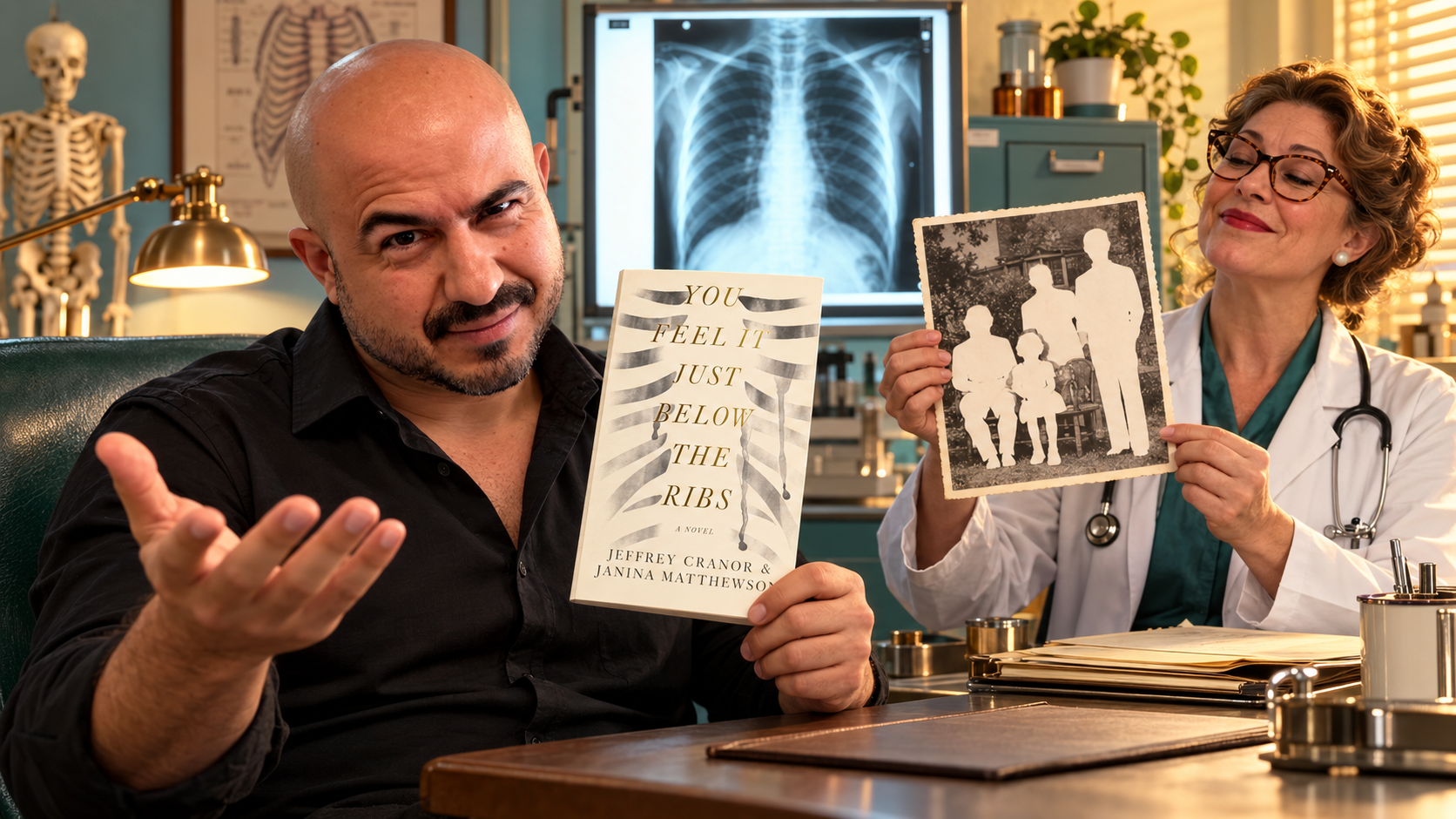

I would like a second opinion on Dr. Miriam Gregory.
My book club spent an hour discussing whether Dr. Miriam Gregory was a victim, a villain, or the kind of doctor who says, “This will only hurt a little,” and then you wake up with no memory of your mother.
Miriam is the woman at the center of Jeffrey Cranor and Janina Matthewson’s You Feel It Just Below the Ribs. She survives a catastrophic war, becomes a doctor, and develops a way to quiet painful memories. She tells us about her life in a memoir, complete with notes from people who occasionally interrupt to question her version of events.
It’s like reading somebody’s confession while a second person leans over your shoulder and whispers, “That’s not how I remember it.”
Naturally, I trusted neither of them.
This was my favorite book club read so far. I thought it was a great story when I finished it, and the four of us found enough to talk about for an hour. The book is vague in places, deliberately so. Usually, that makes me suspicious of a writer. There’s a difference between leaving a door open and forgetting to build the damn wall. Here, the uncertainty gave us something to examine. I could make a case for what I thought happened, so could someone who disagreed with me.
I’m going to keep the big revelations out of this review. Part of the fun is reaching them yourself, then realizing the book may still be withholding evidence.
Miriam grows up during the Great Reckoning, a decades-long war in an alternate twentieth century. She loses people she loves and spends much of her childhood trying to survive. Food, shelter, and a safe place to sleep take priority over the usual childhood concerns, like domestic chores or explaining why the dog ate your homework.
Eventually, the war ends. A new society forms, determined to prevent people from tearing the world apart again. Miriam becomes a doctor and works with people whose memories keep the violence alive long after the fighting stops.
I wanted to see her succeed. After everything she had witnessed, helping someone else find relief felt like a decent use of her life. I also understood why the Society would be interested in her work. If a treatment eases the pain left by war, people are going to want it.
Miriam’s method can quiet memories a person can hardly bear. She sees what it does for people in her care. Then her work begins to reach beyond the relationships where it started. I could follow the logic of each step while growing less comfortable with where those steps led.
The Society has a very pleasant sales pitch: look at all the suffering we can prevent.
I’d ask to see the rest of the paperwork.
I’ve worked in insurance. When someone offers a solution that sounds too simple, I want to know the exclusions. Miriam’s treatment would require a policy jacket the size of a refrigerator, and I’d still be looking for the page that explains what happens when the person administering it changes her mind.
Her childhood gives her choices weight. She isn’t guessing what violence can do to people. She lived through it. When she wants to protect others from that pain, I believe her. Believing her motives, however, did very little to settle my nerves.
Miriam tells her story herself, while other voices appear in notes alongside it, correcting details, challenging claims, and sometimes offering a very different view of what happened.
That structure made me pay attention to the way everyone presented the evidence. Miriam would describe an event, and I’d wonder why she spent so long on one detail while moving quickly past another. Then a note would make a correction, and I’d wonder why its writer was so eager to get that correction in front of me.
I know how easily a person can tell a true story that leaves the listener with the wrong idea. Give me ten minutes and a bad week, and I could probably do it myself. I’d mention my mistakes, of course. I’d choose the ones that made me sound honest, and then I’d move on before you thought to ask about Thursday.
Miriam has had years to decide how to tell this story. The people adding notes have their own reasons for publishing it. Everyone sounds confident enough that I wanted a third opinion, preferably from somebody who had no connection to the Society and didn’t sign his letters “Yours in historical accuracy.”
At book club, we kept coming back to the question of how much to trust Miriam. We could point to things she had done, things she claimed to regret, and things the notes suggested she had left out. My feelings about her changed as we talked. I could sympathize with the child she had been and get angry at the adult she became, sometimes while discussing the same choice.
Would I let her treat me? I would like to say no. I’d like to say I would meet Miriam, hear her proposal, immediately recognize every possible consequence, and walk out with my memories intact.
While reading, I kept imagining the first person who came to her for help. I could picture the relief that might follow. I could also picture how hard it would be to question the treatment once people began to credit it with giving them their lives back.
Later, when the Society sees what Miriam’s work can do, I’m less interested in whether she meant well at the start. I want to know what she noticed as things changed. Did she recognize the danger early? Did she push back? Did she wait until she could no longer bear what she had helped create?
The book gave me enough to argue about those questions. It also gave me enough to wonder whether Miriam was arguing with herself.
When our book club met, nobody had to sell me on the novel. I had finished it and called it great. What surprised me was how much better it became once we started talking.
I had reasons for the conclusions I’d reached. So did the other guys. Then someone would raise a point, and I’d remember a note I had skimmed or a choice Miriam described so calmly that I had taken her calm for reassurance. The discussion didn’t hand me a new answer. It made me want to revisit the one I’d brought with me.
Some books leave me eager to tell another reader what I thought. This one made me eager to hear what he thought, because I suspected he might have caught me missing something.
There were stretches that tested me. The novel covers much of Miriam’s life, and sometimes she takes her time getting to the incident I’m waiting for. I’d be reading and think, Okay, Doctor, I understand this period was difficult. Where are we going?
Then she’d arrive, and I’d realize the long road had changed how I felt about the destination.
I don’t think every reader will have that patience. If you need a quick thriller with a clean trail of clues and a final explanation from the person who committed the crime, Miriam may drive you crazy. She certainly drove me crazy now and then. She would tell me something terrible with the composure of a person describing an inconvenient train schedule. I kept reading anyway. I cared about her too much to leave, and I distrusted her too much to relax.
The book also made me think about how people talk when they’re trying to live with what they’ve done. Sometimes they confess. Sometimes they choose the order of the facts carefully and hope you’ll reach the conclusion they can stand to hear.
I’m still unsure which Miriam is doing at any given moment. I think that’s one reason the four of us could talk for an hour without exhausting her story.
My Diagnosis? I liked Miriam Gregory. I didn’t always believe her. By the end, I wasn’t even certain those two feelings belonged in separate sentences.
I believed she had seen terrible things. I believed she wanted to help people who had suffered. I also wanted to stop her at several points and ask what the hell she thought would happen. The notes made me question her account without giving me another voice I could trust completely.
That combination kept me reading. It kept us talking at book club. It has kept me thinking about the novel long after I returned to my own life, with all my memories still available to bother me at inconvenient times.
You Feel It Just Below the Ribs is the best book we’ve read at the club so far. Read it if you enjoy a story that lets you care about someone while questioning her judgment. Read it if you like an eerie world that becomes more troubling the longer you spend there. And if you have a book club, bring it to them. You’ll want witnesses when you start arguing with Miriam.
I’d recommend her story to anyone, but I would ask for another doctor.
*If you enjoy this review, consider a donation. Much appreciated.
Discover more from Gabriel Lucatero
Subscribe to get the latest posts sent to your email.